Showing posts with label children's literature. Show all posts

Wednesday, October 23, 2013

WIP Wednesday and Yarn-Along

 Quilting on the Farmer's Wife Quilt continues.  This is block #22, Corn and Beans.
 #67, Pine Tree.  Some of the blocks I'm going to do a little special quilting in, but a lot will probably be stitch in the ditch.
 #27, Darting Birds.  Because of the narrow range on my Megaquilter setup, I can only quilt a little over half a block at a time, then I will have to scroll the quilt.  Slow and steady, though.

In other quilting news, Bonnie Hunter has suggested colors for her upcoming mystery quiltalong, Celtic Solstice.  I think this will be a fun one, something to look forward to over the holiday season.

Knitting on Rosalind continues slowly (I'm now at the beginning of the left front), but I want to cast on a new socks project: argyles for Secundus.  He wants blue for the backgound, brown diamonds and that light green for the diagonal lines.  I am reading Fyre, the 7th book in the Septimus Heap series by Angie Sage.  I've reviewed the previous books (link to the first 2) in the series, and by interesting coincidence, Redeemed Reader has a review recently.  Great series of middle-school appropriate fantasy.  I really want to get back into book reviews, but it's parent-teacher conferences this week.  Sigh.

Linking up to WIP Wednesday and Yarn-Along.

Sunday, September 15, 2013

Book Review: The Rithmatist

The Rithmatist by Brandon Sanderson was recommended to me by my son Daniel, who loves nothing better than a multi-volume epic fantasy saga set in a complex and engrossing world.  Sanderson, famous for writing such tomes himself and even taking on the completion of epic fantasies begun by another author, simplifies his usual style in this book aimed at the Young Adult market.  Although it is the first in an intended series, it's easy to get into and quick to read if you're a distracted teen, mom, or teacher who has no time at the present for slow-moving epics.  I read it back in August but this is the first real book review I've done in awhile because, well, Pinterest has made it much more challenging to embed pins on one's blog and I have only just (maybe) figured it out.

Joel, the young hero, is an under-performing student whose one dream in life has already been crushed - he wanted to become a Rithmatist, a sort of wizard who engages in dueling by drawing chalk figures that come to life; but he missed his chance of being chosen at a mystical "inception" ceremony and is now too old, seemingly destined for a sub-par career and a life of poverty.  But all that changes when mysterious events at Armedius Academy transpire and Joel is thrown together with the Rithmatic students and professors.  He befriends Melody, a rather annoying girl who is underachieving for her own reasons, but has a knack for drawing chalkling unicorns.  Together they seek to find the cause of the attacks on students that are somehow linked to alarming events in the larger world -- the mysterious tower in Nebrask.

Like all recent YA fantasies, this book is obviously indebted to Harry Potter, but the "school story with a twist" actually reminded me more of the Pixar film Monsters University, with its overall lighthearted feel.  This is also a good introduction to the related genres of "steampunk" and alternate history.  Without being hackneyed or derivative, though: Sanderson has plenty of invention of his own.  The illustrations by Ben McSweeney contribute nicely to the feel of the book, and there is no objectionable material or disturbing violence.  Look closely and you may be able to detect echoes of some Mormon theology, perhaps.  I found it a bit odd to see the suggested discussion questions and book report project ideas at the back -- but Daniel assures me this is standard procedure these days.  I guess fantasy lit has come a long way if its authors now plan ahead for their books to be school assignments!  Back in my day, there was a bit of a stigma if you read this type of fiction.  I'm glad that's changed, but I'm not sure I'd kill the enjoyment of a book like this by turning it into an assignment.  A fun, different, refreshing read with potential for more enjoyment to come.

Monday, January 21, 2013

Book Review: The Hunger Games

America has fallen.  The powerful and wealthy ruling elite have crafted a new society for their sole benefit, ruthlessly oppressing the majority and imposing a vindictive system of reparations upon those who have opposed them in the past.  These punitive taxes, or "tributes" serve a dual purpose; to prevent the subjugated masses from even the smallest sign of dissent, and to secure the most luxurious and decadent lifestyle possible for the favored few as they run society in the way they please.  Bread and circuses: it worked for the ancient Romans for quite some time, after all.

This is, of course, the scenario of The Hunger Games, the phenomenally best-selling dystopian novel by Suzanne Collins.  I like my writing to have layers, so you may draw your own conclusions about how I feel about the events of the most recent election cycle.  The Hunger Games was my first real foray into the "Young Adult" category of children's literature, and at least in part I felt compelled to read it since it is phenomenally popular among young people I know, and touches on the political intrigue and convoluted history of the ancient Romans.  I don't normally gravitate to edgy or dystopian fiction myself, but this trilogy is deservedly popular, and of course, there is a major motion picture now, making it a book that kids are eager to read and parents are concerned about.  For a review of the series from a Christian perspective, check out this one from Redeemed Reader.  I plan to review the series in three parts, and hope to avoid giving spoilers, although when I get to the 2nd and 3rd books I will have to refer to events of the previous books.

The first thing you are struck by in the opening pages of the novel is the first person narrative, and the second thing is the present tense.  The entire series plays out this way, drawing us into the very mind of heroine Katniss Everdeen with an immediacy that is impossible to deny, rather like the command performance of the Hunger Games where every citizen of Panem is forced to watch children drawn from the twelve districts kill each other for the entertainment of the Capitol.  Once you have read the first few pages, it is almost inevitable that you will be swept along with the story to its conclusion.  It's hard to stop after the first book; there is an insidious power that draws you in, even though Katniss is far from a likeable heroine and the world she inhabits is bleak.

I have heard that most young people do not find the book disturbing but treat it as just a "what if" scenario.  Adults tend to take a harder line against it; and not because of lack of literary merit or author's ability.  In the wake of the Connecticut school shootings especially, a world where children kill children for the entertainment of adults is something we would prefer to keep unthinkable, and my own first reaction was that it would have been better if this book had never been written in the first place.  Some questions should never be asked, and some thoughts should never be entertained, and it may very well be better for most people never to be forced into the mind of someone who must either kill or be killed.  But the book was written, and we who work with young people need to deal with it in an intelligent way.

As Katniss volunteers to take her beloved little sister's place as a tribute from insignificant District 12, we are carried along with her into a different world from the life of deprivation and oppression she has known until now.  She has developed the ability to provide for her family in a meager way by sneaking into the woods to engage in illegal hunting with her best friend, a boy named Gale.  But all that abruptly changes when she and Peeta, the more middle-class son of the town baker, are treated to makeovers by image consultants and stylists to present them along with the other 22 contestants at the gala opening ceremonies.  Plot points unfold at a breathtaking rate; Katniss herself is too caught up in the circumstances to think of the future, but Peeta sets up a gut-wrenching love triangle when he reveals on national TV that he loves her.  But only one person can win the Hunger Games, and it's unlikely to be either one of them.

I assume that Suzanne Collins wrote this postmodern trilogy with the intent to promote an old-fashioned anti-war message, updated for a generation of kids who are comfortable with sharing every thought on social media.  But the very medium she uses, with immersion into the mind of the protagonist who must kill to stay alive, is the literary equivalent of those violent first-person shooter video games that most responsible adults would like to remove from their children's lives.  It's the same senseless bloodbath in an artificial world created only for killing, but with a better vocabulary.  At the end, Katniss has either been forced to kill in self-defense, or killed somewhat accidentally, or killed in mercy, or helplessly witnessed the deaths, of several human beings.  One wonders if this has the same deadening effect on the soul of the reader, who shares Katniss' eyes, as those shooter games.  Granted, Katniss acts with a more or less consistent moral integrity, albeit in a world completely empty of a religious presence of any kind.  But she shows little ability to think over the moral component of her actions, or their future implications beyond the immediate threat.  Perhaps this is meant to illustrate the teenage mind, with its tendency to live only in the present, and its tendency toward narcissism.  That's just the thing, it's hard to tell whether Collins is being moralistic or simply using modern techniques to tell an action-packed story in an amoral setting.  I tend toward the former, but she hides her preachiness very well.  Maybe that's a good thing for this generation.

My own opinion on the book is that you shouldn't encourage your child to read it at all before the age of 15 or so, and then only if you are willing to discuss it with him or her rather extensively.  There are some young people who really shouldn't read it at all... those with depressive or violent tendencies especially.  The theme of suicide is particularly disturbing from my point of view, and (not to give spoilers or anything) its use as a possible game strategy.  I cringed a bit when I saw a 6th grader lending the 3rd volume to a 7th grader a week ago.  Yes, it is possible to read these books thoughtfully.  And those who are not thoughtful enough at this point of their lives to appreciate the questions they raise will certainly remember them vividly when they get older.  Still, I will try to keep my own children away from the Young Adult ghetto of moral ambiguity for awhile yet.

Thursday, December 6, 2012

Book Review: The Legend of Luke


The Legend of Luke, by Brian Jacques.  Although this was the twelfth book written in the Redwall saga, it falls chronologically early in the series.  Martin the Warrior, after the events of Mossflower, is living quietly among the good folk at Redwall Abbey.  The Abbey is still under construction but promises to be a haven of peace for the gentle woodlanders.  However, a travelling hedgehog maiden, Trimp, inadvertently triggers some long-forgotten memories of his childhood, laying upon Martin the burden to find out the story of what happened to his father, Luke.  Only a quest through many dangers will suffice to bring the knowledge he seeks; knowledge both of his father's fate, and of his own character.  True to the Redwall pattern, he is joined by many friends, old and new; Trimp, Dinny the mole, Gonff the mousethief, the young squirrel Chugger, and a rather memorable hare named (for short) Beau.  Much of the later part of the book is told in flashback, a tale-within-a-tale that gives us the noble lineage of Martin's sword, and suggests why he is willing to put it aside at the end.

Some have critiqued the Redwall books as being repetitive; there is always a quest, always at least one horde of evil vermin, always a desire for peace which only comes at a high cost.  If they are repetitive, I believe they have the best kind of repetition, the kind that bridges the gap between old and young and leaves us all wanting "more of the same, but different."  As I have read these books, I have begun to see recurring themes as well; in this book particularly, the sacrifices the older generation must make to protect the younger; the inherent nobility of an unselfish character, the qualities of bravery and leadership which emerge in necessity; the tension between the need for war and the desire for peace.  In a larger sense, Redwall Abbey and the noble woodlanders who dwell there are a metaphor for the island of Britain, constantly beseiged and in need of able defenders, but a beacon of civilization in a dark world.

If you enjoy audiobooks at all, these are well worth listening to: the late Brian Jacques himself narrated them with music and a full cast.  I believe they are the kind of children's books that all children should be exposed to.


Friday, September 21, 2012

Book Review: Martin the Warrior


Martin the Warrior, by the late Brian Jacques, is chronologically second in the Redwall saga, following Lord Brocktree.  Of all the Redwall books I've read, I think in this one Jacques was exploring more advanced themes than in his typical work.  There are few of the wordplay puzzles and archetypal quests that draw young readers into his other books; instead, it is a tale of slavery and resistance, a serious meditation on the evils of war and vengeance, and definitely closer to a tragedy than a comedy, even with the light and humorous characters that populate it.

The story follows the hero mouse Martin, a natural leader, as he follows the painful path of a hero in his attempt to defeat the evil stoat Badrang, reclaim the stolen sword of his father Luke, and free his enslaved friends.  Along the way he meets Felldoh the squirrel, Brome and his sister Rose of Noonvale, and the faithful mole Grumm.  Badrang has troubles of his own trying to recapture the escaped slaves and hold onto the fortress of Marshank while Clogg, his old enemy, threatens to take it over.  There's also a troupe of travelling actors, a kind-hearted cartographic owl, and dangerous cannibal lizards, among many others.  The book suffers a little from a cast of thousands approach, so that it's hard to remember all the characters, but you can be sure they all have a role to play before the end.  This is an approach that will appeal to children who are proficient readers and enjoy exhaustive detail in epic form.  Jacques was inspired to become an author by reading the great epics, and he does not set the bar low for his readers.  Younger children can enjoy it as a read-aloud, as with all the Redwall books.  Especially if the reader can do the moles and other voices well!

The story of Martin is a prehistory to the events of Mossflower, before the founding of Redwall Abbey.  It also sheds light on the character of Martin, both a driven and a reluctant warrior, and why the peaceful Abbey, when it is built, is a metaphor for all that is good in a dark world.  Jacques wrote many books in this series: if you're only going to read three, this should be the third after Redwall and Mossflower.  Or you can attempt the great Redwall race and read them in chronological order along with me.  I might finish in a few more years!

Wednesday, September 12, 2012

Yarn-Along with Martin

I'm linking up to Ginny's Yarn-along today.  This is my September shawl in the 12-shawls-in-2012 challenge.  It's the EZ 100th Anniversary Camping Half-Circle shawl, and it's a free pattern in honor of the late Elizabeth Zimmerman.  It's not really called EZ because it's easy, or anything!  I'm using my handspun Wensleydale light fingering/ wannabe laceweight, and right now it looks like nothing great.  Maybe it will be pretty when blocked.  That's the thing with lace knitting, it's a leap of faith that you didn't make a mistake and that it will be gorgeous when blocked.  I'm in the "willow leaves" next-to-last repeat and the rows are more than 300 stitches long right now, but still haven't used up my first ball of yarn.  I have lots and lots of willow leaves to go.

I'm trying to finish up Martin the Warrior, the second book (if you count them chronologically) in the Redwall series by Brian Jacques.  I reviewed the first, Lord Brocktree, a few months ago.  Quarta and Daniel and I were doing the great Redwall race, but Quarta has finally kicked in and during the last weeks of summer vacation, she sped through several books and is now all the way up to Rakkety Tam.  Maybe I can review Martin in a few days.  I think Daniel has forfeited by going off to college, but it's mission accomplished in getting Quarta hooked!

No WIP Wednesday today because the start of school has meant no time or energy for quilting for awhile, but I did photograph the shawl on the Chinese Lanterns quilt on my bed.

Monday, July 9, 2012

Monday: Time Trials

On the design wall, nothing has changed since last week.  I've been almost exclusively focusing on spinning, with a little knitting during swim lessons.  No quilting, not even a stitch on the arrowheads blocks.  But the parts for the Grace Frame have arrived and I am trying to get them uncurled.  Once they are a little more relaxed (and I am too), and I have some heavy-lifting help from Steve or Daniel, I'll try to put them on, reassemble the Megaquilter, and get some machine quilting done.  I'll probably also need to buy thread.  I have big ambitions to get Jack's Chain, Orca Bay, and Farmer's Wife all quilted this summer.  But you know, summer is always too short!
The Tour de Fleece is speeding by, and I have spun up about half of the orange superwash for my second Rhinebeck sweater.  I'm washing the 10 skeins I have today and hanging them out on the line to dry.  After plying the yarn and measuring it off, you are supposed to "set" the twist by soaking or washing it gently, then giving the skein a few good thwacks against something hard, like the edge of the sink.  This seems to shock the wool fibers into good behavior for some reason, and any extra twist in the yarn from over-spinning or over-plying goes away.
I noticed that in the Tour de France, they present the winner of the Maillot Jaune with a bouquet of yellow roses and a stuffed lion.  It just so happens that this little stuffed lion was in the bag of things from the girls' room that were supposed to go to Goodwill.  So I appropriated him as my mascot.  Now I don't know if he'll end up at Goodwill or not!
Of the 10 skeins so far, each one a different permutation of 3 different plies (there are 5 dyelots total, so I marked the skeins "123, 124, 125, 134, 135, 145, 234, 235, 245, 345".  Now, in my attempt to make every skein different, I'm going to ply 2 strands of the same dyelot with 1 strand of a second; I won't have enough to try every possible combination, but that's probably just as well.  I really like dyelot 1 on the left of Aslan: it's a rich reddish copper that I'd be happy with if I had reproduced every time.  But I also like dyelot 3 on his right -- a very saturated orange with red mixed in.  The other dyelots have pluses and minuses; 2 can be a little too tangerine, 4 a little too brown or incompletely saturated, and 5 has a definite black/gray cast.  But combined in various ways they definitely make a yarn with continuous interest.  I'm looking forward to making the sweater during the Ravelympics!

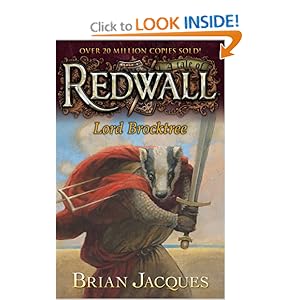
Book review: Lord Brocktree by Brian Jacques

The Great Redwall Race of 2012 -- The short story: earlier this spring Daniel challenged Quarta to a chronological read-through of all the Redwall books that she hadn't yet read or had read to her.  He was supposed to read them all, not skipping any.  Well, he's backed out in favor of re-reading the Belgariad, but Quarta has finally caught on that these books are a great thing.  She whined a lot at first, but patience and good children's literature won the day and she's working on The Long Patrol now.  Here's the chronological list we're going from.

If you haven't yet experienced the Redwall books, what in the world are you waiting for? If there's a child in your life, that child needs a bedtime story like these.  You can start with Redwall itself or with Mossflower, but why not join us with Lord Brocktree and experience from the very beginning the panoramic sweep of the grand tale of the goodbeasts who must fight for freedom against vermin hordes?  Join Dorothea Duckfontein Dillworthy, Dotti for short, that young haremaid of Fatal Beauty, along with Lord Brocktree the badger, questing for Salamandastron, the fabled mountain ruled by an ancient line of noble badgers.  Other beasts, moles, shrews, mice, otters, and squirrels help them along their way.  There is always good food, gentle humor, positive character development, and a clear delineation between good and evil.  In this book, the evil role is taken by Ungatt Trunn, a wildcat with an unnatural liking for spiders and world domination.  He conquers Salamandastron and Our Heroes must raise an army to win it back.  Thanks to teamwork and self-sacrifice, and helped a bit by the tendency of the evil hordes to turn on each other, they will ultimately be victorious and provide a stirring tale for young creatures to hear after the feast.

If it sounds familiar, it is basically the same plot in every novel.  And there is absolutely nothing wrong with that.  Tune in for more book reviews in the Redwall race as the summer progresses.

Friday, May 18, 2012

Quilts of the Past: Once Upon a Time

Amy's Creative Side

Okay, there's this Bloggers' Quilt Festival going on over at Amy's Creative Side, and I have a quilt to share.  It's an older quilt, like the one I shared last fall during the festival then.  And like that one, it was a group project from when I was a member of the informal "Hearts and Hands" quilting group that met at Peggy P.'s house back in Denver in the late 1990's.  I estimate I finished it in 1999, maybe right before we moved out here, although my memory's a little hazy.  And it must have been the pregnancy stress at the time, because I committed the cardinal sin of not making a label for it.  Shocking!  ... and shame on me.  In my defense, we moved twice during that pregnancy, my mother was diagnosed with cancer, and my daughter was born with Down syndrome, so I had other things on my mind.
Once Upon a Time

The story:  This is a round robin quilt.  We all chose a theme and a color scheme, and we all made a theme block as a focal point.  We had a foundation grid of cheap lining fabric marked off into 4" squares.  Each month the box would travel to a new person, who was responsible for making the equivalent of 6 4" blocks that elaborate the theme. It could be one big block or several smaller "filler blocks, or a combination.  Blocks would get moved around the grid a little every month but I had the final say on how they would get arranged.  It was a lot of fun because every member of the group had a different theme: gardens, a Colorado mountain town, camping in the mountains, the seasons of the year, school... those are the ones I can remember.

My theme block.  I was in my applique phase at the time.
A knight errant...
a fearsome dragon...
Jack and the beanstalk, the goose with the golden egg...
the cat and the fiddle, the little dog, and the cow over the moon (the dish and spoon are real little trinkets sewn on there)...
a treasure hoard...
the princess and the pea.

This quilt hung in my oldest son's room from about the time we moved here in 1999 until we remodeled his room to get rid of the ugly old paneling the quilt was helping to cover up.  It might have hung in Secundus' room for awhile too, I'm not sure.  After the remodel at some point it got shelved because some of the treasure needed to be stitched back on, and I remembered it a few weeks ago when I was doing the intervention on Primigenitus' room while he was deciding which college to go to.  So I stitched the treasure back on (I had saved it in a special little bottle in my sewing room!) and hung it up in the upstairs hallway by the staircase.  It had been put away so long, the girls didn't remember it.  And they love fairy tales!  So it's enjoying a new round of popularity.

I couldn't possibly have made all these lovely blocks on my own, and I am honored and humbled that so many wonderful and amazingly creative ladies spent so much talent making them for me.


Tuesday, May 1, 2012

Book review: Harry Potter and the Half-Blood Prince

Source: imgur.com via Katherine on Pinterest

J.K. Rowling's fantasy masterpiece takes on a different tone as she begins winding up her saga in Harry Potter and the Half-Blood Prince.  Up until this book, even in the darkest and creepiest scenes of books 1-5, Harry and his friends are kids and there is a pervasive sense of swashbuckling adventure.  That sense doesn't disappear in the 6th book of the series, but Harry and co. are no longer children.  Nor is this a book for children in the traditional sense.  If you've read my previous reviews of the series (and if you haven't, they are here: book 1, book 2, book 3, book 4, book 5), you will be aware that in my opinion, books 1-3 are appropriate for children but books 4 and up require greater parental involvement and discernment.  They simply may not be appropriate for your child at the present time, and only you can tell for sure. 

I have two sons who grew up with Harry Potter; we discovered the series when book 4 was about to come out and quickly read through the first three books.  Book 4 wasn't that much later although I had reservations about some scenes, and then my firstborn had to wait along with the rest of the world for each new installment every few years.  It built family togetherness and a deep appreciation of reading - both of which are priceless.  But it also gave my boys time to grow a little and develop some maturity to deal with the darker themes that run through the entire series, but especially through the final two books.  With my daughters it's a little harder.

The evil Lord Voldemort is gaining power but there is not yet open war in the wizarding world. Harry Potter has learned from some of his missteps in the 5th book: his relationship with kindly old wizard Albus Dumbledore has deepened and he is called upon to help the headmaster in some important quests, although he is not entrusted with full knowledge of the circumstances even yet.  Some are calling him "the Chosen One," while he and his friends would like to be normal teenagers, falling in and out of love and grousing about the staffing changes at Hogwarts.  Much of the book is concerned with laying necessary groundwork for the final book.  I may be the only one to think so, but it seems to me that the Pensieve as a device for relaying backstory information is just a trifle cheap: "and then Harry looked into the magic Pensieve and saw what (x-character) had seen many years ago)." It works, but just barely.  Voldemort, it appears, has engaged in a particularly evil form of black magic; not once, but many times, he has attempted to ensure his own immortality by creating horcruxes.  (And it may be just because I'm a Latin teacher, but I think it should be horcruces.  But anyway.)  Harry still struggles with intense hatred and suspicion of Professor Severus Snape and his classmate Draco Malfoy.  Is it unreasonable?  And, as will be a theme in the 7th book as well, should Harry continue to act on blind faith and loyalty even when everyone else is telling him otherwise?  Between the 5th book and the 7th book, Harry changes from a moody teenager into a leader.  This book is the turning point that allows that transformation.  There are still plenty of moody teenager moments, but the trend is upward.

Unfortunately, a major character has to be killed off at the end of this book, and great turmoil ensues.  (I myself had the ending spoiled for me by one of the worst types of Muggles at Reagan National Airport on July 17, 2005, who was talking loudly on his cell phone -- as I sat reading my hot-off-the-presses British edition -- and revealed the big secret.  Pthbtbtbt!!! I was unable to enjoy the book for a few years because of him!)  The ending is necessary but deeply unsettling and the only solution for that is to read onward to the 7th book.  Spare a moment of pity for those of us who had to wait years between them!

This book is appropriate for ages 13 and up, and may be suitable for mature 10-year-olds.  Possible areas of concern: teenage romances, dark scenes, scary creatures called Inferi, themes of death, deception and betrayal.

Sunday, March 25, 2012

Book Review - 100 Cupboards


When I saw 100 Cupboards by N.D. Wilson at my local Target, I was excited and snapped it up even though it didn't fit the birthday gift requirements I was shopping for at the time.  Why excited?  For one, N.D. Wilson is the son of the Classical Christian Education movement's guru-in-chief, Douglas Wilson, and his book appearing in paperback on the Target shelf was pretty convincing evidence that classical education has gone mainstream. For another reason... hello? Magic cupboards leading to other worlds?  Since I first read the Narnia series nearly 40 years ago, books like this one go immediately to the top of my reading list. 

Henry York arrives by bus in the dusty town of Henry, Kansas after his flaky parents get themselves kidnapped while biking in South America.  He is taken in by his kindly Aunt Dotty, eccentric Uncle Frank, and three cousins; placid Penelope, nosy Anastasia, and Henrietta, closest to him in age, impatient and competitive.  He is awakened at night in his attic room by a banging sound and pieces of plaster falling away from the wall; curiosity takes over and he finds an entire wall of small cupboards and a mysterious set of dials to control them somehow.  The "somehow" takes a while to discover, but with Henrietta's help he is able to find out a tantalizingly little bit more about the worlds behind the doors.  There is an evil witch plotting world domination, and some scheming magicians and their servants, and at least one old man with a long-concealed secret.  The conclusion of the book comes too quickly for full resolution and we are left with a certain unsettled expectancy to look forward to the next two books in the trilogy.

Modern children's entertainment -- I hesitate to use the word literature -- tends to be extraordinarily derivative in both style and content.  I walked through a book fair at my 6th-grader's public middle school the other day and I could categorize very rapidly: paranormal romance; paranormal comedy; teenage angst; Harry Potter rip-off; nonfiction that reads like bathroom wall graffitti; increasingly desperate offerings to get underachievers hooked on reading.  Wilson's writing is having none of that, but it is derivative in the best way: inspired by the rich layers of children's literature past, it remembers its roots and sends out new ones.  The reader who has also been inspired by the great children's books will be set off on a treasure hunt for literary allusions... they are hidden with subtlety and skill, but they are there.  I imagine that this trilogy began with a series of speculations based on favorite books:

What if Dorothy never left Kansas? What if beings from other worlds came to visit Kansas instead? What if Eustace Clarence Scrubb went to live in the Pevensies' guest room; what kind of pictures would he find there? What if the kids from E. Nesbitt or Edward Eager met up with Neil Gaiman's Coraline and things turned really scary?  What if the parents of the kids, instead of being dead or removed from the story, had stories of their own? And what if ordinary American things, like pocket knives and baseball bats and grumpy old cats, had significance above their usual function in the fight of good vs. evil?

I have to say, I'm looking forward to the movie that ought to come of this book. Wilson's style is modern enough to be very visual and the movie is waiting right there in the text, ready to be released from its marble prison like Michelangelo's statues.  The publisher recommends it for ages 8 and up, but I would say 10 and up might be safer: my 9-year-old found certain parts very "creepy" (though this did not at all stop her from reading and liking it) and the overall tone of the book is dark and often frightening.  Like all children's literature, too dark and frightening is in the eye of the beholder; and children often surprise us with their ability to cope with frightening stories.  This is the same 9-year-old who listened to Coraline on audiobook when she was 6 or 7, with no nightmares on her part (there may have been some on mine).  I am only partway into the second book of the series, but it does appear to be even darker.

Sunday, February 12, 2012

Book Review: Cornelia Funke's Inkheart Trilogy

I have "read" several books as audiobooks in the last few years, many of which I would not have the time to read otherwise.  Some of the best of the lot have been by Cornelia Funke.  She is a German writer, but her works have been lyrically translated into English and there has even been a major motion picture (although, as almost always happens, it isn't as good as the books).  Advanced readers of any age will like her Inkheart trilogy, which is directed at the juvenile market but may be long and deep enough to dissuade younger or more struggling readers.  There is also an emotional intensity and menacing sense of evil that may disturb some younger readers; but the books are largely free of objectionable material found in many "young adult" books.

In Inkheart, (audiobook ably read by Lynn Redgrave) we meet Meggie and her father, Mo, a bookbinder with the disturbing ability to read characters out of, and real people into, books.  This is, in fact, what happened to Meggie's mother long ago; Dustfinger, a displaced character from the Inkworld, is searching for the man who might be able to put things right again.  But so is the ultimate bad guy, Capricorn, and he has been written to be the ultimate bad guy.  The ability to read people ... and things like treasure ... out of storybooks makes Mo the man everyone wants to control.  Meggie and her father join forces with her bibliophile aunt Elinor to find Fenoglio, the author of the obscure book that started it all.  The adventure ranges all over Europe to its culmination in a medieval Italian village.

The second book of the series, Inkspell, continues the not-quite-resolved issues from the first book; although really, the first book ends at a satisfying point and the sequel was not strictly necessary.  Once it has begun, though, and we are drawn with the main characters into the fantasy world of Inkheart, it imprisons us there, in a world which is lovely to read about but not quite so lovely to experience firsthand.  New villains (Mortola, the Adderhead) arise to prominence and new characters add their complexity to a storyline that begins to escape the control of the fictitious author, Fenoglio.  This book is darker than the first, more frightening to read, and does not deliver a completely satisfying ending; by this time the real author knew that a third book would be written.  The book-within-a-book theme is further developed, but some readers will be put off by the themes of suffering and fated death.  Brendan Fraser does the reading for the audiobook: he played Mo in the movie and delights in a whimsical portrayal of the various characters (If you enjoy Fraser's voice performance, perhaps an even better, standalone Funke audiobook is Dragonrider).

The third book, Inkdeath, attempts to bring order to the chaotic situation in the Inkworld.  There are so many characters by this time and so many dark, confusing and sometimes conflicting storylines, and it had been so long since I had listened to the second book, that I'm glad it was an audiobook or I would have given up.  But, with all that said, the development of the characters and the plot, once it finally gets close to the denouement, is superb.  You feel like it's a bit of a slog getting there, though.  Part of it is intentional: the theme of how to redeem a cursed story where everything is going wrong is prominent in this book even more than the others.  Modern fantasy authors like to tease their readers -- will this be one of those authors who kill off main characters and leave you in a depressed (pardon the bad pun) funk?  Thankfully, this is not.  The resolution of this book, although some characters do get short shrift, is satisfying in a classical way, while at the same time inventive and new.  I came away from the audiobook (read by Allan Corduner, who has an impressive list of audiobook credits) feeling happy that I had ventured into the Inkworld and met its engaging characters.

In a way it is easier for those of us who grew up passionately devoted to books and reading to separate fantasy from reality in reading these books.  We know quite well that it is impossible to bring characters from a book to life by reading aloud, or we would have done it ourselves by now.  So it is easier to appreciate the Inkheart trilogy for what it is: an homage to books and book lovers everywhere, and an exploration of what life might be like if fantasy and reality did collide.  Perhaps drawn out a bit too long, perhaps taking too many characters in too many different directions, it is still a delightful and memorable read... or listen. 

Tuesday, January 31, 2012

Book Review - Guardians of Ga'Hoole series - The Owls Have It

Young children go through phases with their reading, most of them driven by the basic human need for security.  In early childhood they want the same bedtime story read to them over and over again, and parents go mildly insane doing 100 reps of Goodnight Moon or, in my case, The Cow Who Fell in the Canal.  Then when they first begin to read, it's repetition of simple sounds and words, like Sam-I-Am in Green Eggs and Ham.  The jump to chapter books is an important one, and it's not a coincidence that there are many books in simple chapter books series like The Boxcar Children.  My children started reading the Boxcar Children when they were anywhere from 4 to 7 years old, and two of the four have read every available book in the series ... but no child I've known has ever continued reading the Boxcar Children past age 9 or 10.  The repetitious format of formula fiction is self-limiting, and kids must move on.  Many times, they move on to something like the Guardians of Ga'Hoole, a series of chapter books about heroic owls by Kathryn Lasky. With many books to bring back familiar characters, this series offers more literary merit and more complex storylines.  But still, the reading level is most appropriate for ages 7 to 12, with few over that age who are more than tolerant of the overall story.

I admit, I was dubious about Lasky's Ga'Hoole books after reading her Memoirs of a Bookbat, a Judy-Blume-ish adolescent memoir about the evils of censorship riddled with badly-disguised bigotry against evangelical Christians.  But my firstborn son had fond memories of the Ga'Hoole series: he said it kindled a love of heroic fantasy literature in him and he compared it favorably to Brian Jacques' Redwall books, which we all love.  There is a film version of the first three books, with gorgeous animation and visual effects, which our family watched on TV, although I dozed off at a few key plot points (probably no fault of the movie, I was just very tired). So I gave the series a try, checking out audiobooks of the first three books from the library, and listening to them in the car with the family.  They had great production values, and the writing is very good.  Lasky has written close to 100 books, and she knows all there is to know about plot and pacing and character development.  But I can't say I love these books.  Maybe it's the juvenile gross-out humor and TMI about every minute detail in owl life.  Maybe it's the improbability of believing in a post-apocalyptic world where owls have evolved to take the place of humans, including mastering metalworking and warfare.  But I think most probably it's the idea that some owls evolved an abnormal psychology that necessitates domination of other owls through brainwashing and concentration camp tactics.  It's most likely an attempt on the author's part to portray World War II in a less threatening way so kids can process it.  But if you're looking for an animal fantasy/adventure story for elementary readers, I believe there are better options.

Some children's books you just can't wait to read to your kids; some, if you have eager readers who outstrip your ability to stay ahead of them, you just hope will not damage your kids if you never get around to reading them first.  The Ga'Hoole books do observe this primum non nocere principle, mostly.  The action is engaging and, if you don't overanalyze things like I do, there's always something exciting happening.  There are several charming characters: Soren the barn owl, Gylfie the elf owl, Mrs. Plithiver the blind nestmaid snake.  So, these books are great fodder for the eager readers, as long as they are not disturbed by potentially dark themes (fratricidal owls who join a conspiracy against owl-kind, ghosts, forced labor and re-education camps under a strange totalitarian system).  As a child, I would have more likely been confused by some of the moral ambiguity in the minor characters, and bored by the technical details about owls' digestive systems.  As an adult I was ready for the third book to be done, and when one of the CDs was unusable, took that as a sign to quit listening and check out something by another author.

Tuesday, January 24, 2012

Book Review: The Grave Robbers of Genghis Khan

I've written before about P.B. Kerr and his Children of the Lamp series, when I reviewed books 1-6 last February.  It's an inventive children's/ YA fantasy series featuring a twin brother and sister who find out they are djinn.  Now the final of the seven volumes has been released: The Grave Robbers of Genghis Khan, and the series has been brought to a mostly satisfactory conclusion, with wit and style. 

John and Philippa Gaunt have had many adventures with their lovably pompous Uncle Nimrod and his grumbling butler, Groanin (including one they don't even remember).  They are enjoying a spot of R&R in Italy when Vesuvius suddenly becomes active and threatens a catastrophic eruption... as does virtually every other volcano in the world.  Clearly, some evil plot is afoot.  To avert a worldwide catastrophe, John and Philippa must join forces with a team of Icelandic vulcanologists and embark on a rollicking quest to stop whoever is manipulating the world's volcanoes.  The secret may lie in an ancient prophecy, the hidden tomb of Genghis Khan, and the race memory of a family of camels that has relocated from Mongolia to Australia.

The series obviously tries to capitalize on the phenomenal popularity of Harry Potter and Percy Jackson; readers benefitted by receiving 7 entertaining books in a little more than 7 years.  The Children of the Lamp has done for djinn what Harry and Percy did for wizards and demigods, albeit without quite the same bestselling status.  But the last few volumes were rushed a bit too much, I believe.  There are certain uneven spots in editing, and certain things it would have been nice to see wrapped up more neatly.  For example, we do not have a final scene with the children's parents, nor are we given a great deal of insight into whether the evil djinn are behind the volcano plot.  Indeed, the bad guys are really not much more than cartoons in this book, though they are very entertaining cartoons.  This is very clearly the final chapter in the series.  Kerr writes an author's note at the end that will be particularly enjoyable to his fans.

My biggest concern with book 7 was that a few (relatively minor) characters are killed off in this book, but these deaths are dropped into the plot almost as an afterthought, and the swashbuckling, tongue-in-cheek tone continues almost without missing a beat.  Modern kids are not likely to be as disturbed as I would have been by this fast pace and somewhat flippant treatment of death, but I'd still be cautious about giving this book out to kids under 10 for that reason (especially if they haven't read books 1-6 yet, because it is meant to be read in order!)  However, the series as a whole has kept a lighthearted tone all along... unlike the Harry Potter books, which grew progressively darker with each volume, I have no problem classifying all of the djinn books as "children's literature" rather than "young adult."  Some parents may be uncomfortable with the Eastern mysticism on which Kerr builds his series, but I heartily recommend the entire series to anyone who enjoys an entertaining fantasy rich with literary and historical allusions.

Sunday, January 15, 2012

Book Review - Harry Potter and the Order of the Phoenix


I haven't done a book review in 2012 yet.  How about starting with one of my favorite of the Harry Potter series: Harry Potter and the Order of the Phoenix.
This book has grown on me.  When I first read it, I felt Harry was too angry, too impatient, and the adults were either too distant, incompetent, or downright malevolent.  But after reading the full series, it becomes obvious that Harry is not just an adolescent with anger management issues.  Rowling is beginning to tie the series together in this book, and the emergence of the dark lord Voldemort with restored powers is only part of the threat to the Wizarding World.  The Ministry of Magic itself is suffering a lapse of leadership, with Cornelius Fudge and his associates trying to downplay public fears by denigrating Dumbledore and Harry as unstable cranks.

Things start badly for Harry, with Dementors attacking him and his cousin right in Little Whinging, and Ministry officials taking the opportunity to try to expel him.  But right-minded wizards have a secret society: the Order of the Phoenix, dedicated to fighting Voldemort. Except, Voldemort is playing hard-to-get. There's a rumor that he's stalking the Ministry, trying to get access to a weapon of some sort. We get to meet several members of the Order, including Mad-Eye Moody and Nymphadora Tonks, and we spend some time in the headquarters of the Order, the Black family mansion.  There, Harry's godfather, Sirius Black, spends his days in virtual solitary confinement with only Kreacher, a sour old house-elf, for company.

Soon the action shifts to Hogwarts, where Harry is surrounded by rumors and doubt.  Only his immediate circle of friends seem to trust him, and a few weird new characters like Luna "Looney" Lovegood.  Kids who have ever had an unfair teacher, or adults who have ever been caught in nasty workplace politics, will love to hate Dolores Umbridge, the new Defense Against Dark Arts teacher.  Seriously, if you thought the nanny state of Orwell's 1984 was bad, Umbridge will take it to the next level.  But Umbridge's regime provides the spur for some of Rowling's best scenes ever.  Harry's friends band together to learn the skills they will need from him, and they find the perfect room of requirement for their forbidden activities.  My personal favorite character, Professor McGonagall, knows just how to handle a twit like Umbridge.  And Fred and George Weasley have their moment to shine as well.  Oh yes, and Hagrid finds his next of kin.

The theme of friendship and the loyalty of friends, as always, is a major one in this book.  Harry's self-doubts, his impulsiveness, his irrational angry spells, though, mean that it is one of the more introspective of the series.  A major character does die in the last chapters of this book, and Harry blames himself.  Although the book may read like a humorous, swashbuckling romp, the serious ending makes it better suited for those older than 10 or 11.  As I've noted before, this poses a problem for parents whose kids race through the earlier books.  I'll be stalling my 9-year-old for at least another year.

A word on the movies:  I'm a firm believer in requiring kids to read the books first.  The movies will give you the essential plot and feel of the series, but you will miss so much that makes reading a joy.  That said, I like many things about the movies, and am frustrated by a few things.  The first two movies are fun and family-friendly, a great start to the series and an introduction for the illiterate.  The third is very well-made, darker, and is considered by many fans and purists one of the better films.  I'd consider it the best of the first 5 films.  I was frustrated by the 4th film, which is impossibly fast-paced and seems like a breathless highlights reel of the book; so much so that the emotional impact of the final scenes is diminished.  The 5th movie does a better job of editing, but had to eliminate many of my favorite characters and scenes.

My other Harry Potter reviews:
Sorcerer's Stone
Chamber of Secrets
Prisoner of Azkaban
Goblet of Fire

Friday, December 30, 2011

2011 Reading Challenge Recap

For the last 3 years now I have kept track of all the books or book-equivalents I've read, in a thread in the Ravelry Book Challenge group.  What... doesn't everybody use a social networking site for knitters to keep track of books read?  It makes perfect sense to me.  I met my goal of reading 100 books in 2011.  I do have a somewhat flexible definition of "book" and "read."  I count audiobooks, magazines (as long as I've read almost all of the issues in a year), craft books, children's books, and lecture series or classes.  It all goes to the improving of the mind.  Mostly.  I find it helpful to categorize my reading by the categories of fiction (which includes all fiction, bedtime stories for the kids as well as what I read for fun), craft-related nonfiction/ how-to, and other nonfiction.

I've managed a good number of book reviews on the blog (* beside the books I remember doing; I don't have time to link back to all of them now but you can search tags for "book review") and am planning to review a few of these still.  If you want to request a review of one of these that I haven't already done, drop me a comment! I love doing book reviews. I've got similar goals for 2012 reading, and will be trying to work in more reviews.

Fiction:
(1) Inkspell, Cornelia Funke (audiobook) Jan.
(2) Emperor: Time’s Tapestry Book 1, Stephen Baxter, Jan. *
(3) Calling on Dragons, Patricia Wrede (audiobook), Jan.
(4) Teatime for the Traditionally Built, Alexander McCall Smith, Jan. *
(5) Letters from Pemberley, Jane Dawkins, Jan. *
(6) Persona non Grata, Ruth Downie, Feb. *
(7) Little House in the Big Woods, Laura Ingalls Wilder, Feb.
(8) The Five Fakirs of Faizabad, P.B. Kerr, Feb. *
(9) The Double Comfort Safari Club, Alexander McCall Smith, Feb. *
(10) Death of a Valentine, M.C. Beaton, Mar. *
(11) Septimus Heap book 1: Magyk, Angie Sage, (audiobook), March *
(12) The Overton Window, Glenn Beck, March *
(13) Septimus Heap 2: Flyte, Angie Sage, March *
(14) Little Men, Louisa May Alcott, (audiobook) March *
(15) How Right You Are, Jeeves, P.G. Wodehouse, (audiobook with Ian Carmichael), Apr. *
(16) Journey to the Center of the Earth, Jules Verne, (audiobook) Apr. *
(17) The Sign of Four, Arthur Conan Doyle, (audiobook) Apr. *
(18) Vanity Fair, William Thackeray, (audiobook, partial) Apr.
(19) Septimus Heap 3: Physik, Angie Sage, Apr. *
(20) King of Shadows, Susan Cooper, (audiobook with Jim Dale) Apr. *
(21) Septimus Heap 4: Queste, Angie Sage, Apr. *
(22) Septimus Heap 5: Syren, Angie Sage, May *
(23) Freddy the Pilot, Walter Brooks (audiobook), May
(24) Dove Song, Kristine Franklin, June *
(25) Minders, Diana Hendry, June
(26) Saturnalia, Lindsey Davis, June
(27) Septimus Heap 6: Darke, Angie Sage, July *
(28) Clan of the Cave Bear, Jean Auel, July *
(29) The Child’s Homer, Padraic Colum, (audiobook) July *
(30) Good Masters! Sweet Ladies! Laura Amy Schlitz (audiobook) July *
(31) The Time Machine, H.G. Wells, (audiobook) July *
(32) The Rummy Affair of Old Biffy, P.G. Wodehouse, (audiobook) July *
(33) Howard Pyle’s Book of Pirates (audiobook) July *
(34) The Valley of Horses, Jean Auel, Aug.
(35) Redwall, Brian Jaques, Aug.
(36) Harry Potter and the Sorcerer’s Stone, J.K. Rowling, Aug. *
(37) Guardians of Gahoole book 1: The Capture, Kathryn Lasky, (audiobook) Aug.
(38) Harry Potter and the Chamber of Secrets, J.K. Rowling, Aug. *
(39) Harry Potter and the Prisoner of Azkaban, J.K. Rowling, Sep. *
(40) Harry Potter and the Goblet of Fire, J.K. Rowling, Sep. *
(41) Guardians of Gahoole book 2: The Journey, Kathryn Lasky (audiobook) Oct.
(42) North by Northanger, Carrie Bebris, Oct.
(43) Harry Potter and the Order of the Phoenix, J.K. Rowling, Oct.
(44) Conqueror, Time’s Tapestry book 2, Stephen Baxter, Oct.
(45) Charlotte Collins, Jennifer Becton, Oct.
(46) Death of a Chimney Sweep, M.C. Beaton, Oct.
(47) Little House on the Prairie, Laura Ingalls Wilder, Oct.
(48) The Saturday Big Tent Wedding Party, Alexander McCall Smith, Nov.
(49) Son of Neptune, Rick Riordan, Nov.
(50) Harry Potter and the Half-Blood Prince, J.K. Rowling, Dec.
(51) The Gray Wolf and other stories, George MacDonald, Dec.
(52) Inkdeath, Cornelia Funke (audiobook) Dec.
(53) Harry Potter and the Deathly Hallows, J.K. Rowling, Dec.


Nonfiction, craft-related:
(1) Alice Starmore’s Book of Fair Isle Knitting, Jan.
(2) Sweater Quest: My Year of Knitting Dangerously, Adrienne Martini
, Jan. *
(3) Knitting America, Susan Strawn, Feb.
(4) Socks from the Toe Up, Wendy Johnson, Feb.
(5) A Knitter’s Almanac, Elizabeth Zimmerman, March
(6) Tudor Roses, Alice Starmore, March
(7) Quilts en Provence, Kaffe Fassett, Apr.
(8) Quilt Romance, Kaffe Fassett, May
(9) Blogging for Dummies, May *
(10) The IT Girls’ Guide to Blogging with Moxie, May *
(11) Best of Fons & Porter Scrap Quilts, Sept.
(12) The Farmer’s Wife Sampler Quilt, Laurie Aaron Hird, Sept.
(13) 1001 Patchwork Designs, Maggie Malone, Sept.
(14) ABCs of Longarm Quilting, Patricia Barry, Nov.
(15) Lots of Scraps, It’s time to Quilt, Stauffer and Hatch, Nov.
(16) Denyse Schmidt Quilts, Nov.
(17) More Quilts from the Quiltmaker’s Gift, Joanne Line, Nov.
(18) Log Cabin Quilts with Attitude, Sharon Rotz, Nov.
(19) The Gentle Art of Knitting, Jane Brockett, Dec.


Nonfiction, philosophy, history, language, etc:
(1) The 10 Big Lies about America, Michael Medved, Jan.
(2) Clutter Cure, Judi Culbertson, Jan. *
(3) Textiles: 5000 years, Harris, Feb.
(4) Into the Region of Awe: Mysticism in C.S. Lewis, David C. Downing, Feb. *
(5) What’s so Great about Christianity, Dinesh D’Souza, March *
(6) 365 Ways to Drive a Liberal Crazy, James Delingpole, Apr.
(7) If Democrats had any Brains, They’d be Republicans, Ann Coulter, Apr. *
(8) Shipwreck at the Bottom of the World, Jennifer Armstrong, May *
(9) The “American Way”: Family and Community in the Shaping of the American Identity, Allan Carlson, May *
(10) Henle Latin I, May
(11) Henle Latin II, May
(12) An Unexpected Journey: Discovering Reformed Christianity, W. Robert Godfrey, May *
(13) Myths of Greece and Rome, H.A. Guerber, June *
(14) Life After Death: The Evidence, Dinesh D’Souza, June *
(15) Godless, Ann Coulter, June *
(16) Before the Flood:the Biblical flood as a real event and how it changed the course of civilization, Ian Wilson, July *
(17) The Teaching Company: Popes and the Papacy: a History, Thomas F. X. Noble, (CDs) July
(18) The Golden Bough, James Frazer, July *
(19) Demonic: How the Liberal Mob is Endangering America, Ann Coulter, August *
(20) Veritas Teacher Training conference 2011 lecture series, Matt Whitling et al., Aug.
(21) 1st OPC Summer Bible Study on Joshua, Tom Bradshaw, Aug.
(22) The Parthenon Code: Mankind’s History in Marble, Robert Johnson, Sept. *
(23) Sister Bernadette’s Barking Dog, Kitty
Burns Florey, Sept. *
(24) 1st OPC Sunday School class on Westminster Confession, Dec.
(25) Muzzled, Juan Williams, Dec.
(26) World Magazine, 2011
(27) and (28) The Old and New Testaments. Counting this as 2 books (instead of 66), this brings me to a total of 100 books. I followed a chronological reading plan.

Tuesday, November 29, 2011

Book Review - Harry Potter and the Goblet of Fire

Harry Potter and the Goblet of Fire is the fourth of seven books in J.K. Rowling's epic school story with a twist.  In this book, young Harry, raised by completely unsympathetic, non-magical Muggles, learns more about the civil war that is threatening to burst upon the magical world he now views as his true home.  More than ever before, he feels himself at the center of the action as the evil Lord Voldemort schemes to return to full power... and his plans appear to include Harry.  At the same time, there is plenty of rollicking, lively action to keep any young reader's interest, even though this book is longer than any of the first three in the series.

After a once-in-a-lifetime trip to the Quidditch World Cup (Bulgaria vs. Ireland, but it takes place in an undisclosed location in Britain), Harry is back off to Hogwarts, where a new Defense Against the Dark Arts teacher, Mad-Eye Moody, encourages the students to take a more serious view of the threats against them.  These include the Unforgivable Curses of torture, mind-control, and murder... which will play an all-too-prominent role in the action of the series from this point onward.  The really big news is that Hogwarts will host the Tri-Wizard Tournament, a year-long competition between the three major European schools of wizardry.  Contestants from Beauxbatons and Durmstrang will join a Hogwarts champion... but the goblet of fire that chooses the contestants spits out Harry's name, forcing him to compete against champions older and more experienced than he.  It all seems like a plot to get Harry killed, and to complicate matters, his best mate Ron Weasley is jealous of Harry's chance for glory. 

Many characters from previous books make a return appearance in the course of the book; Dobby the house elf and the ghost Moaning Myrtle give Harry some assistance in the competition.  Memorable new characters include the paranoid Mad-Eye, the poison-quilled tabloid journalist Rita Skeeter, the forlorn house-elf Winky, and the never-serious former athlete Ludo Bagman.  As in other books of the series, the themes of friendship and loyalty are large in this book; Harry as a neglected orphan has a greater apprciation for the value of friendship when he finds it and never undervalues an individual who has shown kindness to him. 

Like Harry himself, this book is in transition between the juvenile and adult world.  If you've followed my previous reviews of the series, you'll know that this is the book I won't let my 9-year-old read yet. (She finished book 3 in less than a day when given the green light, and then read it right through again.)  This book begins with the murder of an innocent man and includes another death of a significant character towards the end.  If your child is bothered by books that do not have completely happy endings and simple solutions, it might be best to hold off on reading this one no matter how appealing the earlier Harry books are.  There is also a very dark scene of ritual bloodletting and mutilation which would disturb just about anyone... although the Death Eaters and Voldemort are not in any way portrayed in a positive light and good eventually triumphs, the potential for bad dreams is significant.  Use good judgment in reading this to children under 10.  If they do read it, they will most likely want to continue the series, which deals with increasingly dark and serious themes and kills off more central characters in each book.  In my experience, some kids handle this better than others, and parents know their own kids best.  But for cultivating a joy in reading, there is still nothing quite like these books.

Monday, November 7, 2011

Book Review - Harry Potter and the Prisoner of Azkaban


The third book in the phenomenally popular series by J.K. Rowling, Harry Potter and the Prisoner of Azkaban is the last one, in my opinion, that should be read by a child under the age of 10 without fairly extensive parental oversight and debriefing.  After this, the books grow progressively darker and Rowling becomes one of those authors who Kill Off Characters.  And while the body count in books 4-7 may be appropriate to the context of the larger story arc, and the context may be appropriate for a Young Adult series, the eager 3rd and 4th graders who devoured the first few books may need to wait a few years for some maturity to set in before their parents let them loose on the last 4 books.  This book, I believe, is the turning point.  In many ways it is still a kids' book, and the mischief and pranks and teenage angst are all what you would expect in a kids' book.  But the larger context is a war amongst wizards and the potential return of a great, powerful Dark Lord.  Children discover they cannot trust everyone, and underlying the whole story is the horrific threat of the soul-sucking Dementors.  Even some kids in the recommended age range (8-9 and up) may find parts of it disturbing.

I admit to being torn on this one: my 9-year old really wants to read it and I will probably let her next time she asks nicely.  Her oldest brother read it before he was 8, and the 4th book before he was 10, but I would probably put her off longer than that on the 4th book.  This third book has a movie counterpart that is one of the better adaptations: they are all good in their ways, but this one successfully tells the story and retains the pacing and characterization of the book in a way that the later films do not.  (The later films tend to show only highlights from the books, leaving out the charming bits that make the books such a joy to the eager reader).  For many of us longtime Potter fans, this was the book that made us fans and ensured we would be staking out the bookstores for the new release of each new sequel.  In many ways, the enduring appeal of this series is for adults even more than children, but we probably shouldn't be greedy with this book.  It belongs to children first and foremost. 

In this book, Harry loses his temper with his dreadful Aunt Marge and finds himself on his own, more isolated that the maltreated orphan has ever been before, and expecting any minute to be expelled from Hogwarts.  There is a terrible criminal on the loose: Sirius Black, an escaped convict from the wizard prison, Azkaban.  Even the Muggle world is on the lookout for him.  Harry's best friends, Ron and Hermione, are at odds because Hermione's pet cat keeps attacking Ron's pet rat.  And Harry is afraid he is hallucinating when he sees a giant black dog -- or is it really the Grim, the ominous portent of death, as described by Sibyl Trelawney, professor of Divination?  Things begin to look up when he seeks special tutoring in how to repel Dementors from Remus Lupin, the shabby and occasionally sickly Defense Against the Dark Arts professor.  Hagrid, his first friend, is tormented by his own worries, and Harry's antagonists, Draco Malfoy and Professor Snape, are just as sneering and nasty as ever.  Harry also begins to uncover troubling information about his late parents and their friendships; he is faced with some ethical choices which will have serious ramifications in the future.  The kindly headmaster Albus Dumbledore keeps a close eye on Harry, but not too close until the end of the story: for the one thing Harry must learn is to face his troubles on his own, and win his way through by his own wit, character, and courage.  This he does, showing that he is ready for even more demanding challenges in the future books.

Thursday, September 15, 2011

Book Review: Harry Potter and the Sorcerer's Stone

Source: None via Katherine on Pinterest
It's been a long time since I did a book review, so I'll get back to it with one you've probably heard of.  Chances are good that the vast majority of my blog readers have already read and enjoyed Harry Potter and the Sorcerer's Stone, by J.K. Rowling.  But, as I noticed when I first began teaching at a Christian school years ago, the Harry Potter series is one of the deep lines of division among modern Christians.  I would never endorse children reading something against the wishes of their parents, and if that is your situation, kids, I encourage you to cheerfully honor your parents in this.  But this post is designed to convince you, parents, that you should read this book and consider sharing its richness with your children.  Christianity Today recently published an article on the Harry Potter phenomenon and its enduring literary merit which you might find helpful.  No doubt about it, Harry has shaped our culture, and mostly for the better.  The common objections are still there, but have died down somewhat now that the series has been brought to a conclusion that remains faithful to classic ideals of what is True, Good, and Beautiful.

In this first book of the seven, Rowling creates a character who is almost a stock feature of children's literature: the neglected orphan, despised by his remaining relations, who nonetheless has a special destiny.  In fact, she almost overdoes it, exaggerating Harry's hardships (bullied by his cousin, forced to sleep in a cupboard under the stairs) for fantastic and comic effect.  A large part of Rowling's genius is in her ability to take recognizable literary archetypes and tweak them so that they are fresh and funny.  This is basically a school story, and we have the stock characters: the overindulged child, the aristocratic bully, the teachers' pet, the klutz, the class clowns (they're twins), and the adults who are coincidentally absent when the kids are in the midst of danger, so as to make the story more exciting and immediate.  The only difference is the setting, which just happens to be a school of magic.

Let me assure you, on my honor as a Latin teacher, that none of the "spells" in any of the Harry Potter books are capable of doing anything real, whether harmful or beneficial, other than perhaps making Latin a little more interesting.  Every once in a while I'll be able to tell exactly who in my classes has read the books, just based on their reactions to a single vocabulary word in the list.  Most of the spells are dog Latin rather than the real thing, but with enough similarity to start those kids who are so inclined down the path to classicism.  This would be a good point to mention Harrius Potter et Philosophi Lapis, the elegant Latin translation, which played a significant role in helping me improve my own Latin knowledge.

Themes of this book: friendship, loyalty, perseverance, kindness to the downtrodden, and a willingness to assume responsibility even in difficult matters.  Also love that endures beyond death, particularly the self-sacrificial love of a parent.  Good vs. evil, which is a theme of all fantasy to some extent, is of course present as well.  There are some characters who are completely evil, but they are not always the ones we expect.  Many characters are, just as in real life, deeply flawed but capable of rising to the occasion to do the decent thing.  While this is not a book that specifically inculcates a Christian worldview, there are redemptive themes in,with, and under it, and I recommend it for that reason.  And because it is a rip-roaring fun read that will inspire young people, especially boys, to pick up a book more frequently.  And because I'm convinced I'm a distant relation of Hermione Granger's, and

Cautions: Much has been made of the "occult" themes of witches and wizards.  If you would object to the Oz books because of the good witches, Casper the friendly ghost, or the Haunted Mansion ride at Disneyland, this is probably not the book for you... but the real occult is much darker and more insidious; this is implied in Rowling's books, despite what her detractors may say -- truly evil characters are truly horrible, and the good characters are repulsed by them.  I also felt that Harry is a very postmodern hero with regard to his attitudes toward authority: for example, the orphan Oliver Twist naively blundered into trouble just for asking, "Please, sir, may I have some more?"  But Harry dishes out wisecracks and insults as good as he gets from his oppressors, and frequently breaks school rules when he believes it's necessary for the greater good.  This is why I believe parents and children should read the book at the same time, or parents first, and discuss it.  Also, since this is the first of seven books, and since Harry gets older and the forces of darkness get darker with each book, many parents who had no objections to the first 2 or 3 books of the series will want to wait until their kids are teens before allowing them to read books 4 and beyond.

Thursday, July 28, 2011

Summer Listening - book reviews

Catching up on the audiobooks we listened to recently:
The Rummy Affair of Old Biffy, by P.G. Wodehouse, features some stories that I believe were excerpted from Carry On, Jeeves.  I've talked about Wodehouse before -- if you haven't made his acquaintance yet, it's time.  Jeeves and Wooster stories are a really good place to start.

Popes and the Papacy: a History, by Thomas F. X. Noble for the Teaching Company, was a fascinating and surprisingly fast-moving overview.  In 24 lectures on 12 CDs, we go from "the Rise of the Petrine Idea" to Benedict XVI and beyond.  From my professional perspective, I would have appreciated a deeper exploration of the era from the Apostolic age to the fall of Rome -- but of course that's just the era for which we have very few records.  Basically, the bishops of Rome were the last responsible adults left standing after the Roman emperors retreated to Constantinople and the barbarians invaded.  Hearing about the corruption of the medieval popes is enough to raise any Protestant's hackles; the lecturer is doubtless Catholic because he doesn't probe too deeply here, but neither does he gloss over the less stellar moments of the papacy.  This was the first Teaching Company lecture series we listened to, but I'm sure it won't be the last.

Howard Pyle's Book of Pirates is children's lit of an earlier era.  I always loved his Robin Hood, and in recent years we've listened to audiobooks of Otto of the Silver Hand and Men of Iron: he seems to be one of the classic authors who is well liked by librarians.  I think this is more of a compilation of unrelated stories, put together by a later editor.  They're fun, not too deep, and of course fit in with the recent Disneyland theme.